

Origins: Why FDL.ai Built Hyperfluidity
Hyperfluidity was born out of a practical engineering bottleneck discovered over a decade of building operational scientific AI.
Through the Frontier Development Lab (FDL.ai) and Trillium Technologies — in partnership with NASA, the European Space Agency (ESA), the U.S. Department of Energy, and Google Cloud — our teams have spent ten years training large-scale machine learning and foundation models across radically different physical regimes: from solar magnetohydrodynamics (Heliolab / Surya / SDOFM) and thermospheric drag to orbital dynamics, lunar geology, and terrestrial climate extremes.
Across more than 100 deployed pipelines, a recurring mathematical pattern emerged: purely data-driven foundation models hallucinate at regime boundaries, yet the differential equations required to constrain them share fluid-dynamic isomorphisms across scales. Whether modeling plasma turbulence in the solar corona, acoustic metrics at quantum scales, or gravitational kinematics at cosmic horizons, non-linear fluid dynamics, more often than not, seems to be the missing ingredient.
Initiated by FDL.ai founder James Parr, the Hyperfluidity initiative formalizes this observation into both an open-source physics-informed AI error-correction toolbox and a falsifiable theoretical sandbox — Emergent Hyperfluidity Theory (HFT) — mapping 47 physical, biological, and cosmological benchmarks across a 295-rung base-φ scale continuum.
Hyperfluidity: an evolving and open computational framework
Hyperfluidity is a computational framework and physics-informed toolbox designed to fine-tune large-scale, data-driven foundation models by exploiting the mathematical isomorphisms between hydrodynamics, spacetime geometry, and quantum mechanics. Hyperfluidics acts as a heuristic bridge, utilizing fluid dynamics as a scalable computational shortcut to model complex physical systems across vastly different regimes.
Core mechanisms
Cosmological Fluid-Gravity Isomorphisms: At macro-cosmic scales, the toolbox leverages the established mathematical parallels between fluid dynamics (such as the Navier-Stokes equations) and Einstein’s field equations. It applies the fluid-gravity correspondence strictly at the specific cosmic scales where bulk flow, thermodynamic pressure, and hydrodynamics accurately approximate the curvature of a pseudo-Riemannian manifold, explicitly acknowledging that this isomorphism does not necessarily hold universally across all scales.
Quantum Superfluid Isomorphisms: At the microscopic scale, the framework utilizes the mathematics of Bose-Einstein condensates (BECs) and superfluid vacuum models. By mapping quantum field behaviors to acoustic metrics and phonon interactions within a superfluid, it provides a tractable way for foundation models to simulate quantum phenomena without requiring the brute-force calculation of intractable quantum operators.
Physics-Informed Fine-Tuning: The framework functions as an applied machine learning error correction methodology. It embeds these fluid-based differential equations directly into the loss functions of large-scale foundation models. This ensures that AI-driven simulations and predictions remain mathematically bounded by known hydrodynamic laws, reducing the hallucination rate of data-heavy models when generating physical simulations.
Mathematical Incompleteness (The Computational Shortcut)
Hyperfluidics is explicitly designed as a computational shortcut and remains mathematically incomplete by definition. It sacrifices fundamental, discrete precision for computational tractability for three primary reasons:
Breakdown of Analogy at Extremes (Scale Boundaries): The isomorphisms between fluid dynamics and spacetime are effective field approximations. They inevitably break down at the exact boundaries of extreme physical regimes, such as inside black hole singularities or at the Planck length, where the continuous fluid analogy fails and a true, discretized theory of quantum gravity is required.
Turbulence and Non-Linear Divergence: Approximating high-energy quantum field interactions through hydrodynamics inherits the unresolved mathematical complexities of the Navier-Stokes equations. In regimes of extreme non-linear turbulence, the fluid analogy may produce divergent, chaotic, or unphysical computational artifacts that do not strictly map to quantum realities.
Loss of Fundamental Discreteness: By relying on continuous fluid dynamics as the bridging mechanism, the framework deliberately bypasses the strict discrete quantization (such as individual fermions and strict boson gauge exchanges) demanded by the Standard Model. It operates as an effective macroscopic mapping rather than representing the absolute microscopic truth of particle interactions.
Stress-Testing the Boundary: The 295-Rung Phinary Sandbox
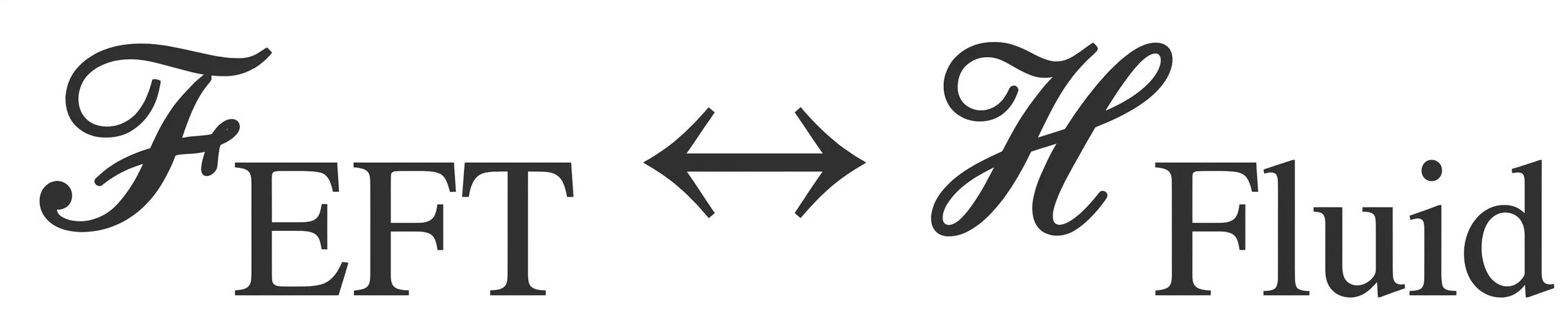
Where exactly do these fluid-spacetime approximations break down — and what happens mathematically if we replace standard Newtonian hydrodynamics with a single, contiguous non-Newtonian hyperfluid? To map the exact failure boundaries of the ℱEFT ↔ ℋFluid isomorphism, we built the Phiral Observatory: a computational sandbox spanning a 295-rung base-φ (Phinary) logarithmic continuum (H[0, 295]) across 73.75 spiral turns from the Planck length (Rung 0) to the Observable Universe horizon (Rung 295). Rather than assuming the fluid analogy fails arbitrarily between quantum and cosmic regimes, this framework models localized matter and spatial curvature as shear-dependent topological phase states of the same continuous medium — allowing the physics and machine learning communities to quantitatively test, benchmark, and falsify where continuous fluid rheology reproduces discrete physical phenomena without free-parameter tuning.
| Physical Regime | Standard ΛCDM / QM Bottleneck | HFT Topological Mechanism | Phinary Rung (H[0, 295]) | Zero-Parameter Output |
|---|---|---|---|---|
| 1. Quantum–Gravity Bridge | Discrete-continuum clash: Quantum fields fail to reconcile with smooth relativistic spacetime at Planck scales. | Topological vortex strain: Matter and space act as continuous non-Newtonian phase states of a single medium. | Rung 0 → Sub-atomic (ℓP Planck Pixel) |
Metric curvature & rest mass derived from fluid shear modulus without renormalization infinities. |
| 2. The 7 Atomic Shells | Axiomatic quantization: Relies on probabilistic wave collapse and empirically fitted quantum numbers. | Pilot-wave standing locks: Hydrodynamic resonances bounded by 4 orthogonal Regions of Irrationality. | Atomic Rungs (Nodes I–IV: 0°, 90°, 180°, 270°) |
7 principal electron shells emerge geometrically via golden-ratio (ϕ) harmonic partials. |
| 3. Biological Midpoint Oasis | No scalar derivation: Standard physics lacks a first-principles explanation for why life clusters at micron scales. | Minimal-dissipation zone: Shear-stability oasis halfway between quantum turbulence and cosmic tension. | Rung ~147.5 (Midpoint of H[0, 295]) |
Exact viscosity window required to sustain self-organizing biochemical complexity. |
| 4. Moon–Earth KAM Orbits | Contingent orbits: Secular stability and orbital spacing treated as historical initial-condition accidents. | KAM torus stabilization: Standing-wave locks along Fibonacci and Lucas (Ln) harmonic phase rails. | Rung 199 (47.40 Hz, Lucas L8) |
Stable orbital ratios and Earth–Moon harmonic lock reproduced from base-ϕ coordinates. |
| 5. Galactic Roar & Kinematics | Ad-hoc Dark Matter: Flat rotation curves and acoustic anomalies require fine-tuned halo parameters. | Non-Newtonian stiffening: Vacuum medium shear-thickens under ultra-low acceleration + cavity resonance. | Galactic → Rung 295 (Horizon, Turn 73.75) |
Outer-disk velocity flattening and acoustic cavity peaks modeled via intrinsic rheology. |
- Primary Framework Preprint (Zenodo): https://doi.org/10.5281/zenodo.23318577
- The Phiral Observatory: Mapping Stability Nodes Within The Hyperfluidic Continuum (Zenodo): https://zenodo.org/records/24023062
- [HFT-FIG-01.01] The Phiral Observatory Schema (Figshare): https://doi.org/10.6084/m9.figshare.34941940
- [HFT-FIG-02.01] The Phinary Sample-Matrix Synthesizer & 47 Benchmarks (Figshare): https://doi.org/10.6084/m9.figshare.34942336
-
Reproducible Codebase: Generated via Wolfram Mathematica notebooks
[HFT-NB-01.01]and[HFT-NB-01.02].
Community Collaboration
Because this framework relies on bounding neural network architectures with incomplete but highly efficient physical approximations, it is an evolving open methodology. We actively encourage the computational physics, fluid dynamics, and machine learning communities to stress-test these isomorphisms, map their exact boundary failures, and help refine the mathematical capabilities of the Hyperfluidics toolbox for a broad variety of applications.