

Public Predictions
09.28.26 ESA’s JUICE reported no flyby velocity anomalies, as predicted.
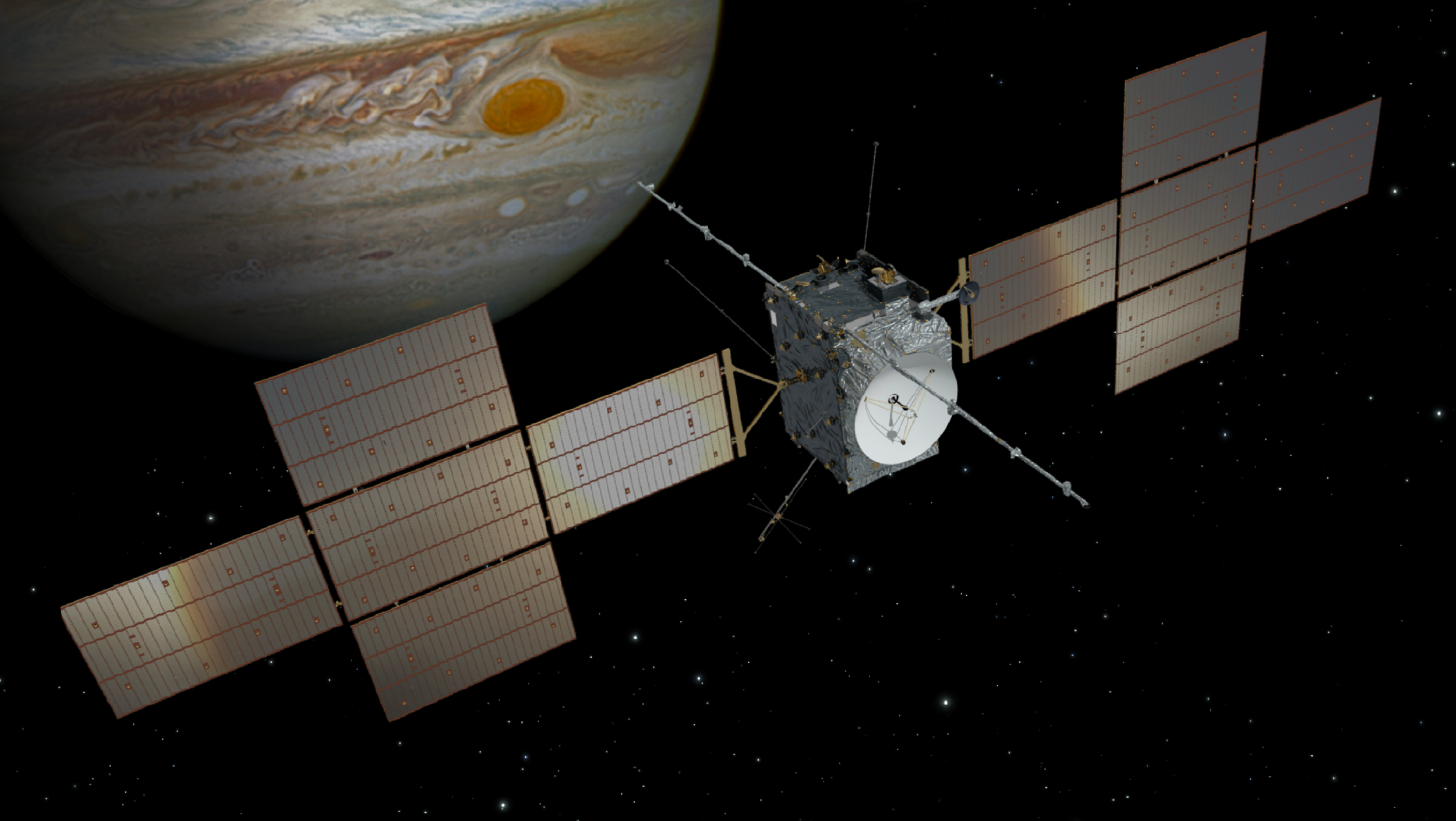
JUICE spacecraft (image credit: ESA)
Following the successful September 28th Earth gravity assist of ESA’s Jupiter Icy Moons Explorer (JUICE) at an altitude of approximately 8,640 km, we can now evaluate the preliminary model recorded on https://zenodo.org/records/23002800. This post-flyby analysis contextualizes the mechanics of the Hyperfluidics framework against the standard telemetry reported by flight controllers.
The event presents a fascinating case study in scale, highlighting an extreme ratio between the macroscopic mechanics of a planetary gravity assist and a microscopic, unmodeled kinematic acceleration. During the flyby, JUICE utilized Earth’s gravity to achieve a massive trajectory correction and a velocity boost of approximately 3.5 km/s (3,500,000 mm/s). In stark contrast, the Hyperfluidics framework predicted a minute positive velocity shift of just +0.2 to +0.6 mm/s. This localized acceleration stems from the spacecraft transiting the Earth’s rotational hyperfluidic environment, where the effect scales with a 1/r^4 decay multiplier. Consequently, the spacecraft’s planned velocity increase is roughly 10 million times larger than the predicted anomaly.
Despite this overwhelming difference in scale, a velocity shift of a fraction of a millimeter per second is entirely possible to detect. Deep space tracking networks routinely measure spacecraft line-of-sight velocity down to sub-millimeter-per-second precision using X-band and Ka-band radio Doppler shifts, meaning the hardware is fully capable of capturing a momentum transfer of this size.
The reason this tiny anomaly is not immediately flagged in standard mission telemetry comes down to Orbit Determination (OD) degeneracy, as detailed in https://zenodo.org/records/23002800. Because JUICE features massive solar arrays, standard OD tracking filters are mathematically predisposed to absorb this unmodeled positive velocity shift. Rather than registering a momentum anomaly, the standard models natively mask the error by artificially inflating the fitted Solar Radiation Pressure coefficient (C_R) to close the orbit. Proving the presence of this specific kinematic acceleration will require post-flight analysis of the raw Doppler residuals to decouple the actual velocity shift from the artificially inflated solar radiation pressure.
Hyperfluidity falsifiable targets
Table 1: Predicted Observational Anomalies
Table 2: Mechanistic Resolutions to Known Observational Anomalies
James Parr, Frontier Development Lab (FDL.ai)
ORCH-ID: 0000-0002-5707-505X
Date: October 9, 2026
License: Creative Commons Attribution 4.0 International (CC BY 4.0)
DOI: https://doi.org/10.5281/zenodo.23316055
| Observational Target | Standard Model (ΛCDM) Hypothesis | Hyperfluidic Mechanical Mechanism | Falsifiable Prediction |
|---|---|---|---|
| Topological Mass Generation | Yukawa couplings via the Higgs mechanism. | The Tension Equation: Observable mass is excess topological drag (E). Stable particles require integer winding numbers. | Nucleon disintegration thresholds map precisely to fractional harmonic decoupling limits. |
| Color Confinement | Arbitrary evolving ratio (/m). | Acoustic Structural Resonance: Thermodynamic relaxation mathematically targets base-structural equilibrium. | The cosmic energy density ratio de/m converging toward 1.618 (). |
| Quantized Orbitals | Probabilistic Schrödinger wavefunctions. | 3D Chladni Resonance: Electrons (0.511 MeV Möbius defects) are mechanically trapped in deterministic standing waves inside the K pressure valley. | Orbital node geometries matching classical 3D fluid-dynamic standing wave equations exactly. |
| DESI DR2 Cosmic Ratio | The cosmic energy density ratio de/m converging toward 1.618 (). | Acoustic Structural Resonance: Thermodynamic relaxation mathematically targets base-structural equilibrium. | The cosmic energy density ratio de/m converging toward 1.618 (). |
| DESI Expansion Rate | Time-varying Dark Energy. | Volumetric Unspooling: Weakening expansion reflects dwindling reservoir of decaying primordial knots (N=-N). | Correlation between regional matter density and expansion rate variance. | JWST High-z Galaxies | Rapid early gas cooling. | Thermodynamic Time Acceleration: High-impedance shards maximize drag, accelerating local chemical time. | Heavy metal ratios (C, O, Fe) outstripping stellar yield timescales at z>10. |
| Galactic Rotation | Cold Dark Matter (CDM) halos. | Volumetric Displacement (K):Fluid pressure gradients from galactic cavitation sinks. | Flat rotation curve edges bounded by base- structural harmonic steps. |
| Quasar Time Dilation | Uniform relativistic time dilation. | Macro/Micro Temporal Decoupling:Fluidic time-drag applies distinct kinetic friction to macroscopic flaring versus localized quantum emission. | Macroscopic flicker rates of distant quasars mathematically decoupling from their optical spectral redshifts. |
| FRBs & GRBs | Lorentz Invariance Violation (LIV) / plasma. | Vacuum Dispersion: The non-Newtonian hyperfluid acts as a frequency-dependent refractive medium over cosmological distances. | FRB/GRB dispersion scaling disproportionately with distance, even across plasma-empty voids. |
| LIGO Merger Ringdowns | Smooth quasinormal modes of a geometric void. | Acoustic Shattering: The merger of crystallized N nodes forces the rigid fluid lattice to physically fracture and reform. | High-frequency acoustic overtones decoupling from standard relativistic ringdown templates. |
| EHT Black Hole Horizon | Smooth continuous plasma accretion. | Yield-Stress Crystallization Boundary:The horizon is a literal structural boundary where continuum shear reaches the non-Newtonian yield limit. | Rigid optical/magnetic refraction gradients at the exact boundary of the crystallized anomaly. |
| Observational Anomaly | Standard Model (ΛCDM) Hypothesis | Hyperfluidic Mechanical Mechanism | Retrodictive Resolution |
|---|---|---|---|
| The Hubble Tension | Arbitrary calibration mismatches. | Localized Temporal Drag: The Milky Way resides in a fluidic under-density, locally altering the clock speed relative to the early universe. | Spatial correlation of H0discrepancies mapping directly to local void densities rather than physical velocities. |
| Ultra-Diffuse Galaxies | Unexplained absence of Dark Matter halos. | Inactive Thermodynamic Shear-Lock: Dispersed stellar density of diffuse galaxies generates insufficient geometric strain to trigger macroscopic shear-thickening. | Outer stellar rotation curves match Newtonian kinematics without requiring bounding mass. |
| Cosmic Birefringence | Isotropic CMB polarization. | Primordial Torsion (K): Macroscopic twisting of ancient light from the hyperfluid's intrinsic spin. | Polarization angle rotation (0.27) matching 4.8 Planck/ACT data. |