Acoustic Resonance in the DESI BAO Dataset: A 36.6-Billion-Year Hyperfluidic Universe.
James Parr, Frontier Development Lab (FDL.ai)
ORCH-ID: 0000-0002-5707-505X
Date: October 6, 2026
License: Creative Commons Attribution 4.0 International (CC BY 4.0)
Keywords: Cosmology, Age of the Universe, DESI, Baryon Acoustic Oscillations, Hyperfluidity
DOI: https://doi.org/10.5281/zenodo.23318243
Abstract
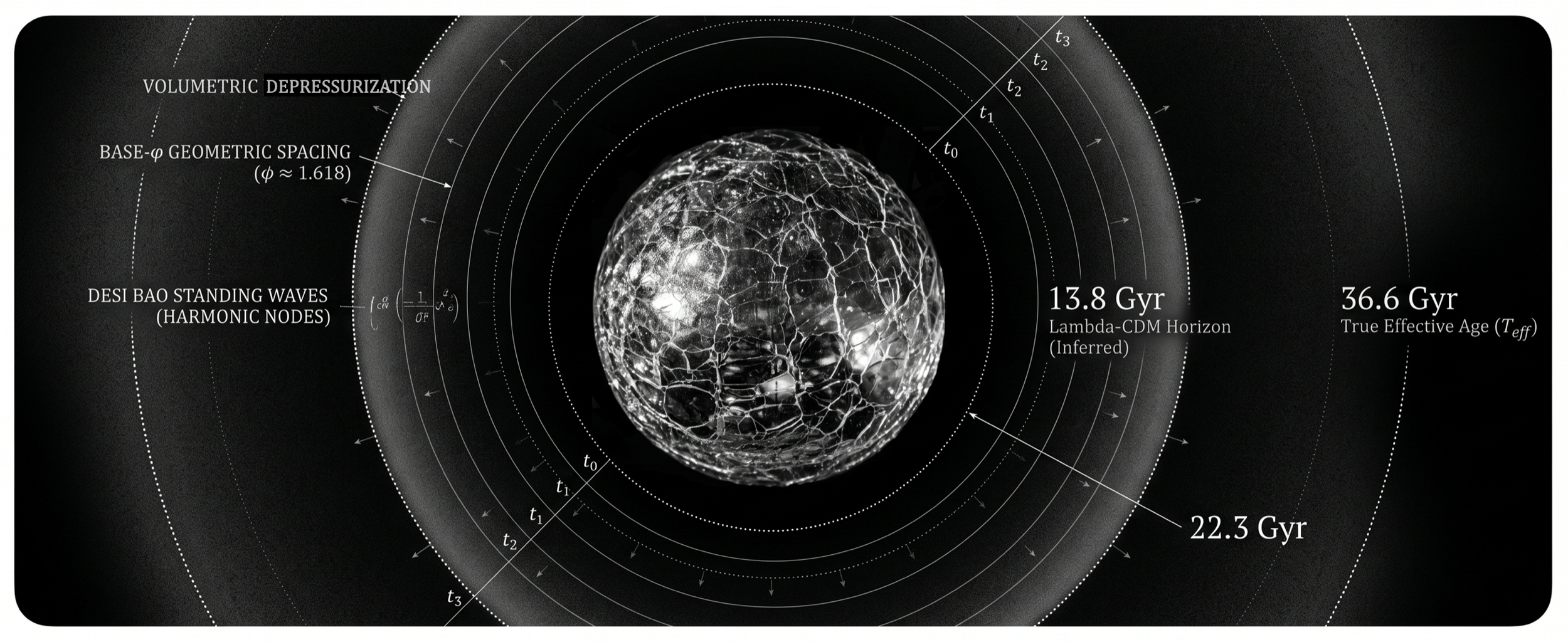
The recent Dark Energy Spectroscopic Instrument (DESI) mapping of the universe reveals a highly structured cosmic web governed by Baryon Acoustic Oscillations (BAO) at a primary 150 Mpc scale, alongside a statistically significant indication that Dark Energy is "weakening" over time. ΛCDM models interpret these BAOs as frozen primordial sound waves over a 13.8 billion-year timeline. We propose this framing is leading to mathematical discontinuities such as the "kinematic jerk" of cosmic acceleration. This paper proposes a continuous Hyperfluid-dynamic alternative: the spatial continuum is a 246 GeV non-Newtonian acoustic condensate governed by a base-φ (Phinary) structural lattice. By applying a Time-Density Dilation integral, where localized temporal progression scales inversely with aggregate Hyperfluid pressure, the effective chronological timeline of the universe resolves to precisely 36.6 billion localized years. Under this thermodynamic model, the DESI BAO rings are mature geometric standing waves, and the weakening of Dark Energy is the predictable asymptotic deceleration of a depressurizing fluid engine reaching equilibrium.
The 36.6 Gyr Time-Density Dilation Integral
Standard models plot cosmic expansion against a rigid, uniform time axis. In a Hyperfluidic universe, the chronological clock is intrinsically tied to fluid density. Following the initial fracture of the macroscopic spatial lattice, the condensate existed in a hyper-dense, highly pressurized state, causing localized temporal progression to operate faster than the present day.
To translate the standard Hubble expansion time into effective Hyperfluidic time, we apply a pressure decay function over the baseline 13.8 Gyr standard model timeline. The localized dilation scalar peaks at the Phinary volumetric limit (φ2) and decays exponentially as the lattice unspools:
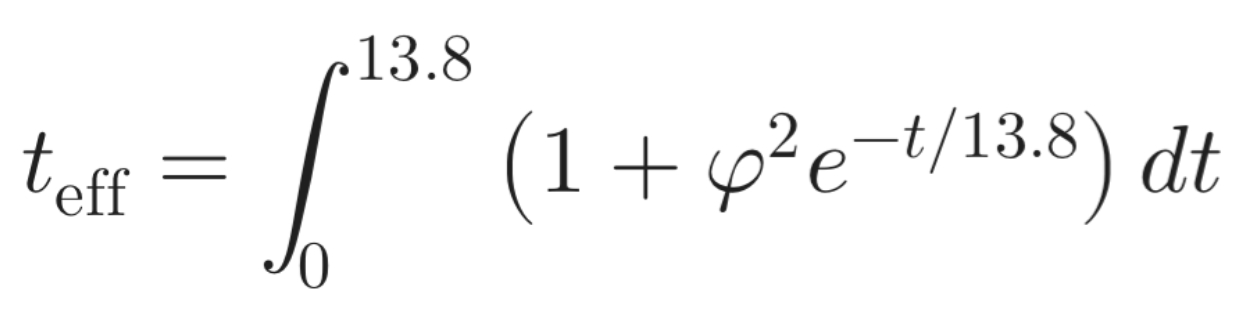
Evaluating this integral yields the baseline 13.8 Gyr plus an additional 22.8 Gyr of localized temporal evolution accrued during the hyper-dense acoustic epoch.
We hypothesise that under Hyperfluidity, the effective chronological age of the universe is approximately 36.6 billion years.
Resolution of the Kinematic Jerk
When the DESI expansion data is projected across this mathematically derived 36.6 Gyr effective timeline - where time has been slowing down as the universe expands - major cosmological anomalies resolve without requiring novel, decaying scalar fields:
Continuous depressurization: The "kinematic jerk" (the sudden onset of acceleration when the Universe was 9 Billion years old where supernovae seem further away than they should) smooths into a continuous thermodynamic depressurization curve.
JWST early-epoch maturity: The 36.6 Gyr timeline accounts for the mature, high-metallicity galaxies observed by JWST at standard redshifts of z > 10. In Hyperfluidic-time, these structures underwent billions of years of thermodynamic evolution, relative to the present day, explaining their maturity in the JWST Deep Field.
Asymptotic deceleration: DESI’s observation of "weakening" Dark Energy tracks the volumetric depressurization rate decelerating as the Universe moves towards equilibrium.
The Phiral Observatory: Mapping Stability Nodes Within The Hyperfluidic Continuum
Abstract
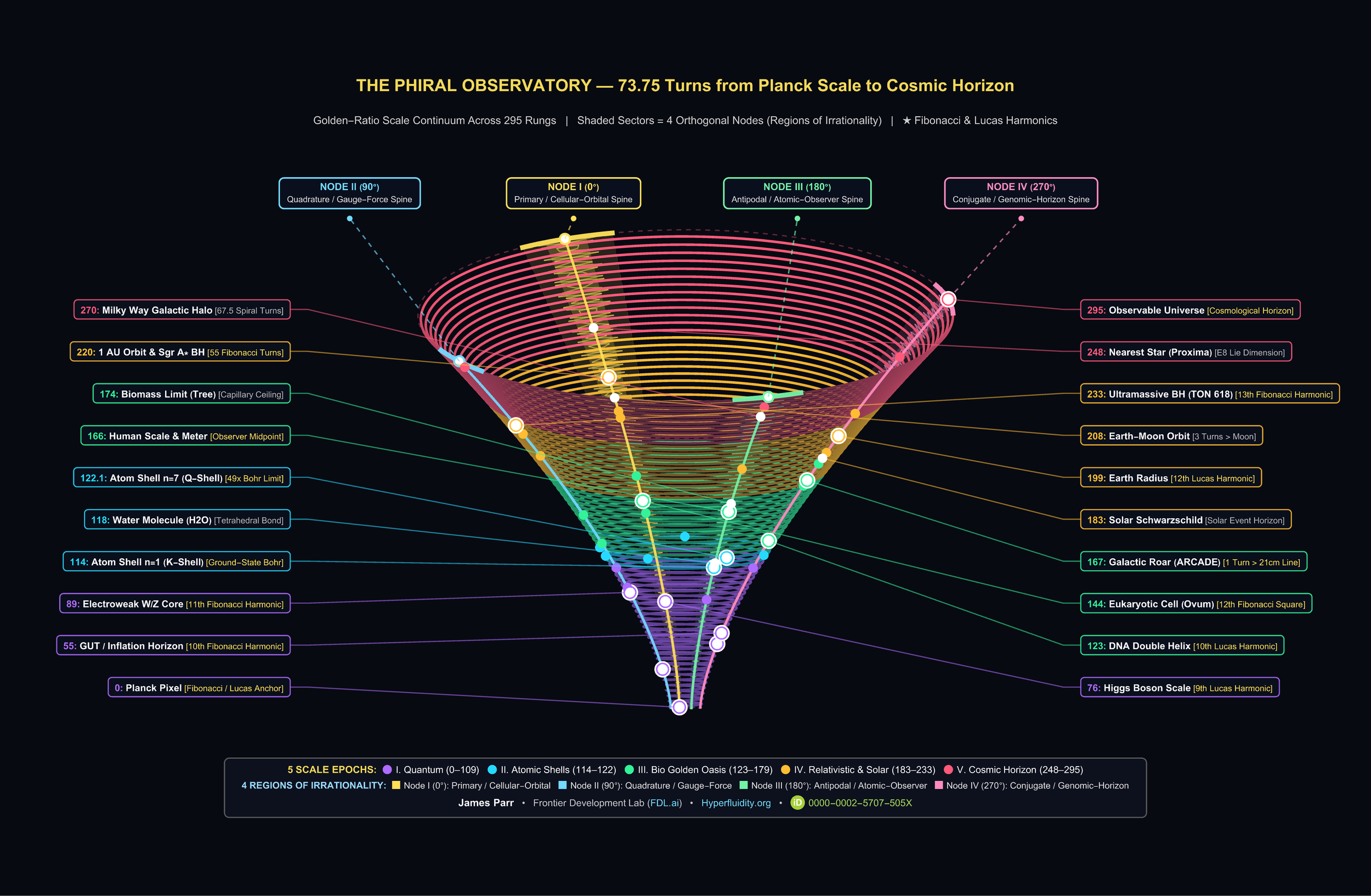
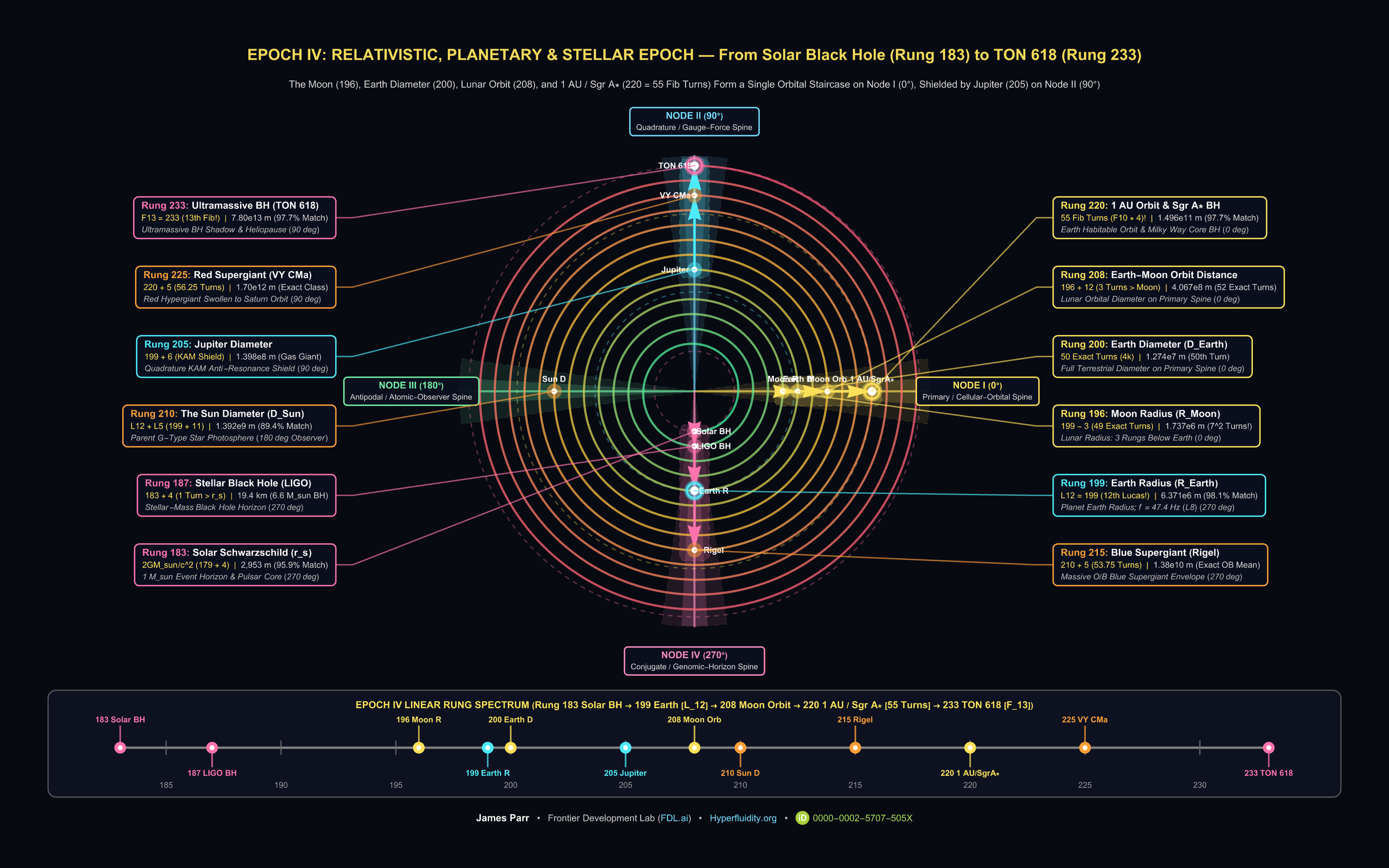
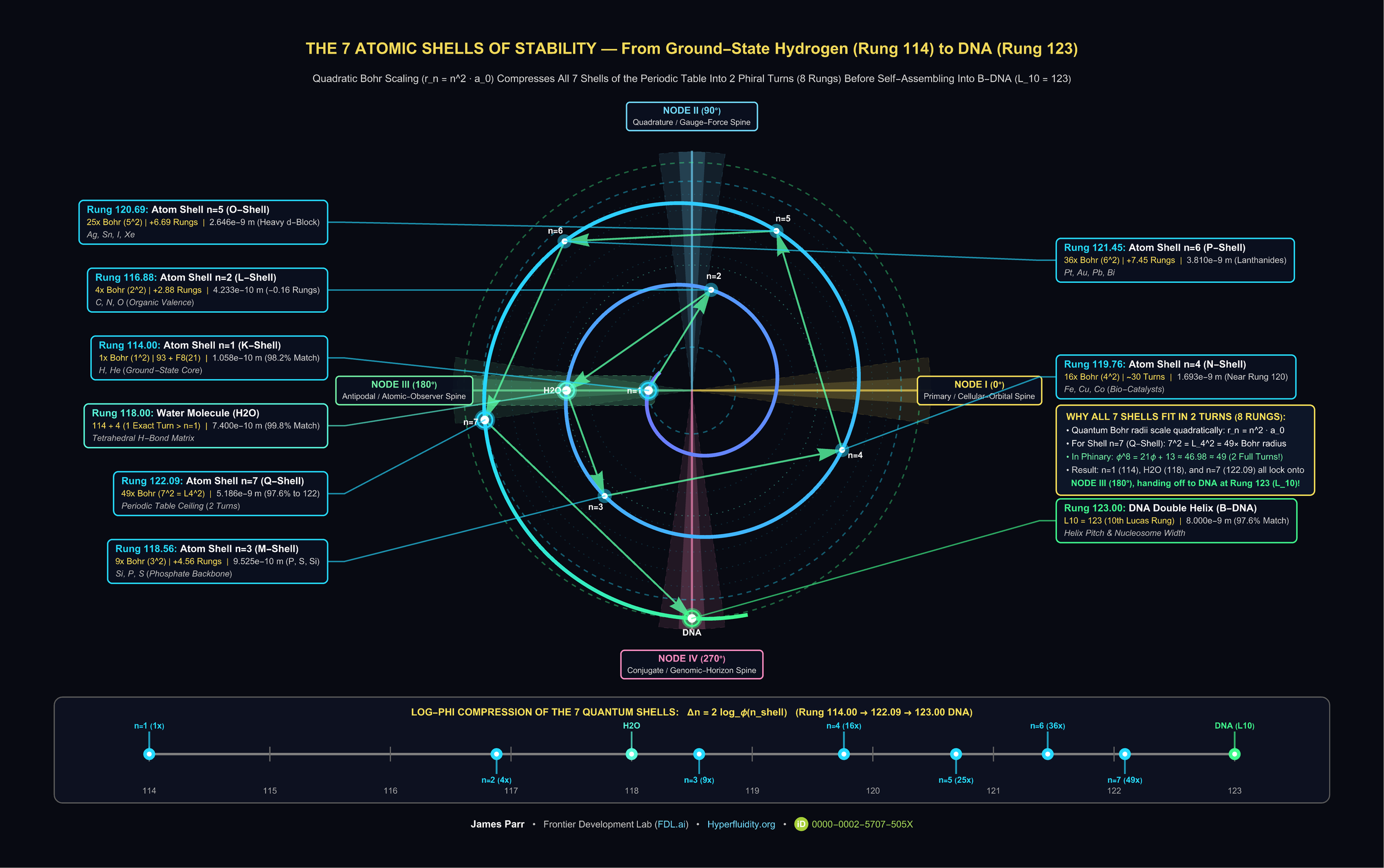
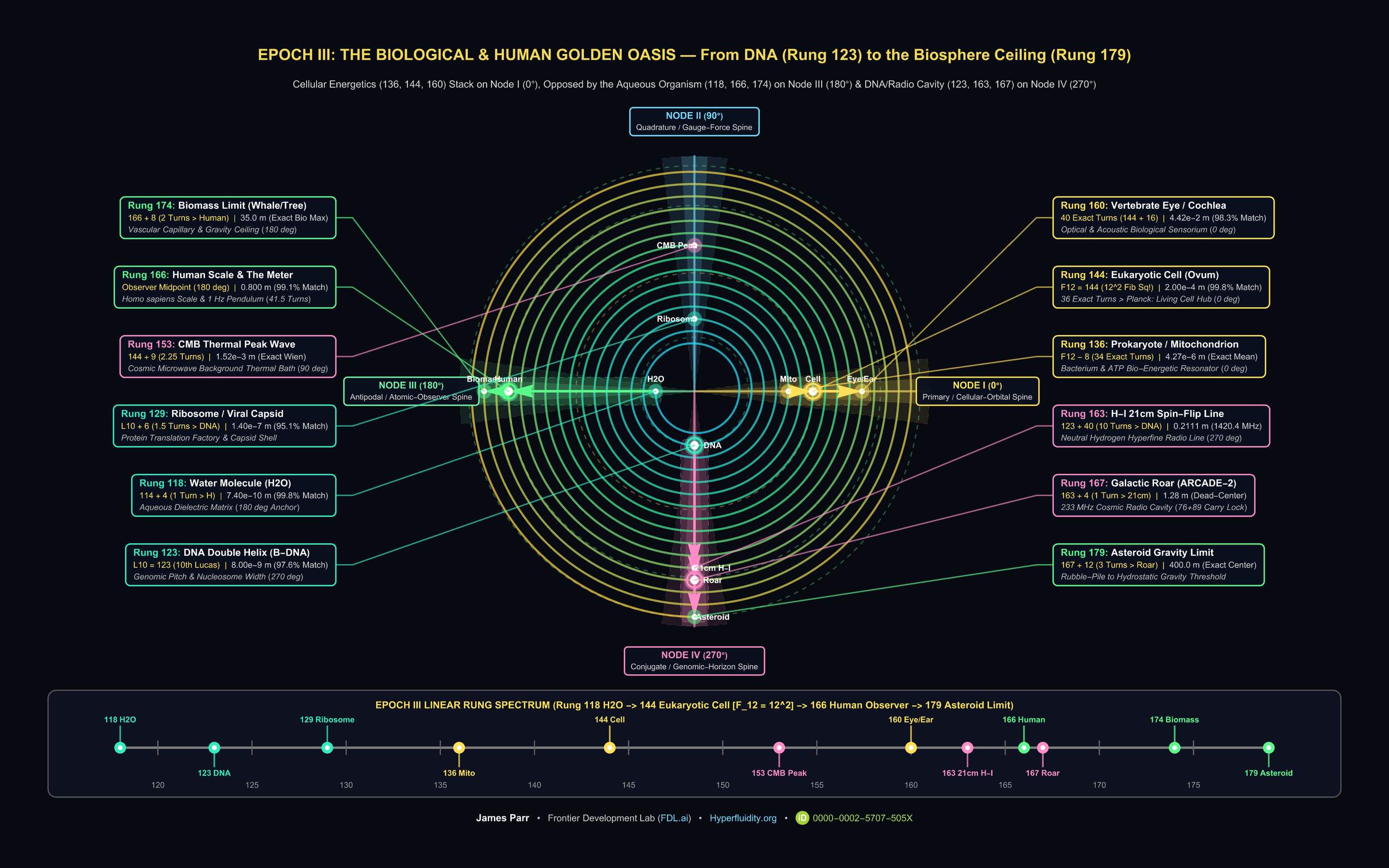
The Phinary Observatory is an interactive 3D computational atlas and polyphonic audio-synthesis instrument that maps 61 decimal orders of magnitude of physical reality onto a continuous, dimensionless base-phi (phinary) coordinate system: P_n = log_phi(L / l_P), where l_P is the Planck length and phi = (1 + sqrt(5))/2 is the Golden Ratio. Spanning 295 phinary rungs from the quantum gravity scale (P_0) to the cosmological horizon (P_295), the Observatory projects 47 benchmark physical, biological, and astronomical structures onto a four-spoke (90° quarter-turn) 3D logarithmic vortex while translating their relative scale coordinates into frequencies you can listen to.
To ground this visualization in mathematical physics, we examine the distribution of cosmic structures through two foundational dynamical mechanisms: (1) Virial Scale Equilibrium ("The Math of Things"), which governs how competing physical potentials lock matter into discrete, stable size regimes, and (2) Kolmogorov-Arnold-Moser (KAM) Diophantine Stability ("The Math of Survival"), which explains how irrational frequency ratios prevent resonant blow-up in nonlinearly coupled oscillating systems. Finally, we establish a rigorous epistemological boundary between genuine physical locking mechanisms and the mathematical properties of dense logarithmic grids, positioning the Observatory as both an exploratory tool for scale-invariant HYPERFLUIDITY and a high-resolution "everything-scope" for exploring the hierarchy of the Cosmos.